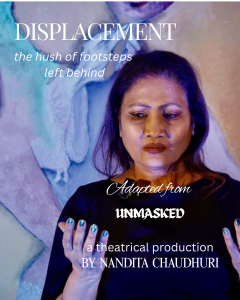
Displacement – A Hush of Footsteps Left Behind
Performance Art/ Theatre Production
Mayfair, London Sept 2025
Where conceptual and visual art defies convention, stretching into uncharted, experimental space
Premiered in the heart of Mayfair, London, September 2025, this immersive, world-first multidisciplinary theatre production brought together poetry, painting, theatre, dance, sound, and technology into a singular visionary experience. Conceived, written, composed, and created by Nandita Chaudhuri, the work occupied a rare space on the London art and theatre landscape, positioning itself not as a conventional performance but as a living synthesis of multiple art forms driven by a single, resonant idea.
The production emerged from Chaudhuri’s deep restlessness with allowing poetry to remain confined to the printed page. UNMASKED, the source text for the work, comprised over 300 poems and paintings, forming a complete literary and visual universe. The poems were used verbatim to compose the songs and to write the dialogues and screenplay, preserving the integrity and cadence of the original language. Unwilling to allow her writing to remain static or contained, Chaudhuri compelled the poems to erupt into sound, movement, and visual form, inhabiting bodies, space, and sensation across the theatrical stage. The paintings from UNMASKED flared into life, assuming animate forms through projection, movement, and light, drawing the viewer into a powerful, visceral dialogue between image, text, and performance.
Structured across four emotionally charged acts and interspersed with contemporary dance, the production unfolded as a multi-sensory journey through a series of universal and philosophical themes. Life and death were presented not as oppositional states but as cyclical, intertwined forces; attachment was examined as both comfort and entrapment; perception and bias were exposed through surreal exchanges that questioned self-image and projected identities. The work culminated in a confrontation with karma, destiny, and free will, inviting audiences to consider whether life unfolds through cosmic design or through chaos embraced and endured.